
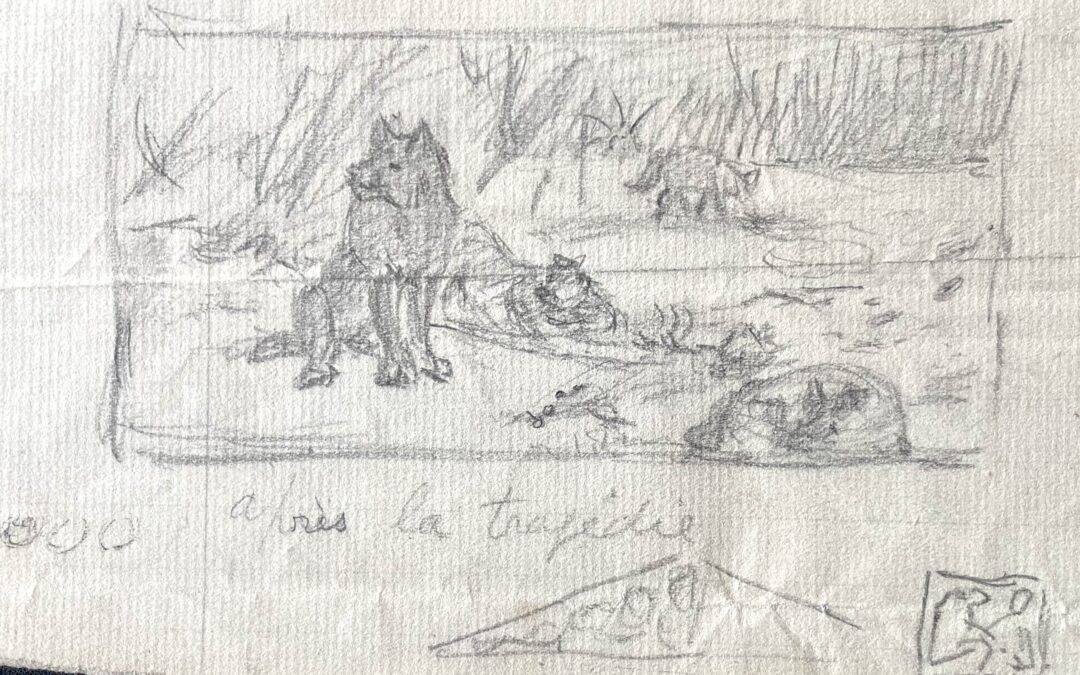
Après la tragédie by Ernest Thompson Seton. Academy for the Love of Learning. All Image rights reserved.
Ernest Thompson Seton made written notes and field sketches during his 1893 hunt for New Mexico wolves. He combined observations recorded in his journal with imagination to create the important and enduring “Lobo, The King of Currumpaw.” I have focused on that story in other sections of this website.
About this work: ALL #0757 Pencil on paper. 12.9 x 20.1 cm. Drawn late 1893 somewhere in northeastern New Mexico. Four wolves: one sleeping (foreground), one standing and another stretching (middle ground) and one standing (background) with scribbled suggestion of landscape elements. In front of the stretching animal are three sickle-shaped forms that could be rib bones. Apparently created from Seton’s imagination as there is no record of his having witnessed this scene.
Top Dogs
Compare this rough sketch to the finished work of Lobo and Blanca where the fierce duo lay claim to their mastery of what the writer Max Evans termed the Hi-Lo county. Seton would have completed that one in his Toronto studio while working on the Lobo story, published in November 1894, which was about a year after creating ALL #0757.
After the tragedy? I am not sure what that means. The wolves are alive, so it seems not to have been their tragedy. Clearly, they are not hunting nor are they running from their enemies. My best guess is that he imagines the wolves in a moment of relaxing. If so, with bellies full, and nothing much to do at the moment of this wildlife tableau, tragedy may have befallen the sheep(s) or cow(s) who provided the day’s meal.