
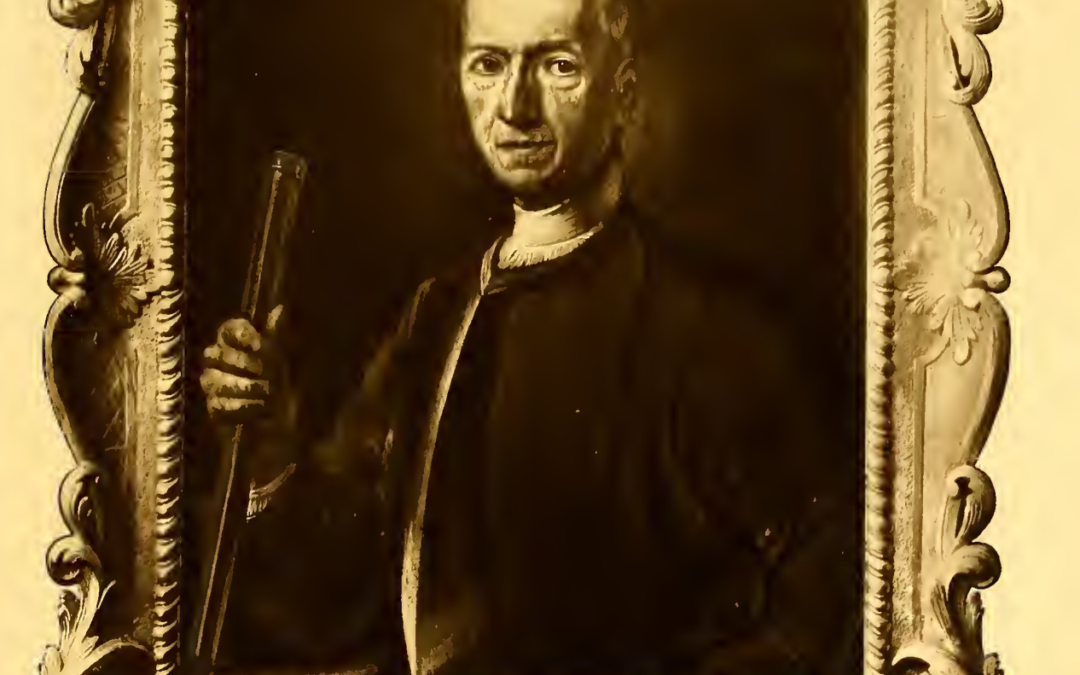
George, Fifth Earl of Winton, reproduced in A History of the Family of Seton, 1896
Ernest Thompson Seton’s ancestor, George, Fifth Lord Seton, was sentenced to death for taking part in the 1715 Jacobite Rebellion. Presumed guilty of treason at the beginning of his 1716 trial, George 5 would have needed both Perry Mason and Mickey Haller to have had much of a chance. Unfortunately for Seton, they weren’t around.
George Seton, Advocate, writing in his 1896 book, A History of the Family of Seton, provides us with the details of George 5’s trial. The portrait of George 5, from that book, is imaginary. He was variously reported as being in Italy or in Scotland. Wherever he was, he must have been a disappointed man.
Before Finally, At Last, We Almost Get To The Trial
When we last left George in Part V of this series he was headed south with a force of Jacobites intending to support the “Old Pretender,” James Francis Edward Stuart, who wanted a new day job as King of the United Kingdom. Jimmy was fluent in French, the country where he grew up. He also spoke English and Latin, but apparently not Scots. He was matched or exceeded in ineptness, perhaps only by his son, Bonnie Prince Charlie. History summary: the Jacobites backed the wrong horse.
But, back to George 5: The Jacobite forces faced a decision as to where to attack the English. The prevailing opinion went in favor of invading England—foolishness adamantly opposed by Seton, who advised that the Scots “would be all cut in pieces.” (Pg. 257) Seton withdrew from the madness, but then changed his mind and rejoined the doomed Jacobites. Many deserted and were captured by the English, taking them out of the coming fight at Preston, September 21, 1745.
The result at the Battle of Preston—the Jacobites with a depleted force—was the debacle Seton had warned of. Seton and four other noblemen were taken prisoner and sent to London to await trial. Pleading guilty, his fellow conspirators hoped for mercy. Didn’t happen. Didn’t end well for them. On January 19, 1716 the four were convicted. Their prescribed punishment: “you must be hanged by the neck, but not till you are dead; for you must be cut down alive, then your bowels must be taken out, and burnt before your faces, then your heads must be severed from your bodies, and your bodies divided each into four quarters.” For good measure, the prosecution added, “God Almighty be merciful to your souls!” Well, one might hope so.
Here ye! Here ye! Here We Go
Seton sensibly pleaded Not Guilty at a hearing on March 8; the trial phase began on March 15. The Deputy-Governor of the Tower (Pg. 259) stood beside Seton, ready with a beheading axe, suggesting that presumed innocent until proven guilty was not a thing in London at that time.
The Lord High Steward outlined the charges against Seton: levying war against the King and supporting James Stuart (who was safely in France away from all the mess he had created).
As we have already seen, Seton claimed to be the victim after the Highlanders ransacked his house; he denied that he had borne arms against the King. The prosecutor countered that he openly supported the rebellion and commanded “a squadron of horse” at Preston prior to being captured. (Pg. 262) A second prosecutor continued to assail Seton with the charge of not having lived up to the obligation of “Loyalty” to the King. He went on to list the damning evidence, including witness presentations. Seton asked to be represented by counsel rather than testifying further himself, citing “Cowper-law,” quoting Seton: “Hang a man first, and then judge him.” (Pg. 264) The name of the lead prosecutor: William Cowper. (Kangaroo Court is the contemporary name.)
The trial continued on March 16
Seton wished the court to hear him regarding matters of fact, a point of law. The prosecutor invited Seton to enlighten the court about the law, but Seton, a non-lawyer, could not do so; laughter in the courtroom. Seton wanted more time to bring forth defense witnesses; he appealed to the Constitution, but the prosecutor countered, What constitution does he mean to preserve?
The prosecutor had had enough; he invited each juror (there were 88 of them) to pronounce on guilt or innocence. Final vote tall: 88 to zip.
“The Lord High Steward intimated to the accused that he had been found guilty of High Treason, which of course, implied that his extensive estates, as well as his ancient honors, were forfeited to the Crown.” (Pg. 265) A windfall for the Crown, certainly.
To Be Continued