
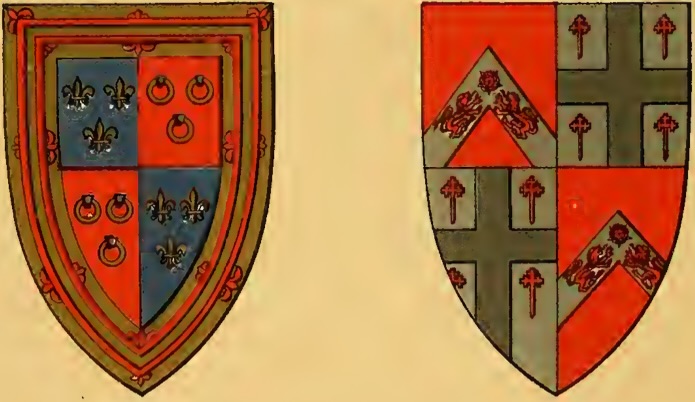
Seton Family Crests, reproduced in A History of the Family of Seton, 1896
Ernest Thompson Seton’s ancestor, George Seton, attempted to retain the title of Earl of Winton in a 1716 trial following the Jacobite Revolution. Part V is the continuing story of two men separated by more than a century. George Seton, Fifth Earl of Winton (the last one to hold the title), held the family property in East Lothian; it had been in the Seton-Winton family for centuries. Another Ernest Thompson Seton ancestor, George Seton, Saddler of Bellingham, held neither property nor title, but sought to change that circumstance.
In the previous parts of this True Law series, we have been introduced to the background of this story (Part I.) We examined the 1825 trial (Parts II, III, and IV). The latter trial was in some ways a continuation of the one from one hundred and nine years earlier. Fortunately for me, as it saves a great deal of work, yet another George Seton, “Advocate,” wrote about the Fifth Earl’s trial in his 1896 book, A History of the Family of Seton During Eight Centuries. The Seton-Winton family never recovered their past glory after this time.
The Fifth George is a Disappointment to the Fourth George
George 5 was destined to become a disappointment to George 4. Regarding George 4, George Seton, Advocate (hereafter: the Advocate), writes in The Family of Seton, Regarding the Fourth Earl of Winton (1642-1704): Educated in France, he “gave eminent proof of his conduct and bravery at the siege of Besancon in Burgundy” (the Franco—Dutch War, in 1674. This conflict, while less known than the Battle of the Bulge, Gettysburg, or Culloden, is important enough to have its own page on Wikipedia!) (Pg. 234) It was for this and other exploits that someone assigned the motto “He Shines With Unsullied Honors” to this George. The motto was given in Latin: Intaminatis fulget honoribus.
For whatever reason, George 5 seems to have been not terribly interested in continuing the family legacy, disappearing for years before returning to Scotland. The Seton-Wintons had been a rather big deal in Scotland for a period encompassing parts of five centuries. The Advocate tells us that George 5 “appears to have quarreled with his father, and to have resided for some years abroad, working as a journeyman-blacksmith.” (Pg. 249) A horseshoe maker rather than a leader of the realm?
George 5 began a period of foreign travels in 1700, returning in 1703 four months before the death of his father. Were they reconciled? History is silent on that one. There is a third trial to add to our account: his property rights seem to have come into dispute, forcing George to provide proof of his identity as well as proof of his legitimacy as George 4’s son. He seems to have made it through that legal hurdle. A bigger problem lay just ahead.
(If you are keeping count, George 5 was the twelfth Lord Seton as well as the fifth Earl of Winton. Pg 250)
Scotland and England: Relationship Problems
Scotland’s forced unification with England (and Wales and Ireland) was already fragile enough when the English imported a German to become King (George I). The Scots preferred James Edward Stuart, a Catholic raised in France with blood ties to an earlier royal line. Stuart’s supporters included Catholics and Protestants, Highlanders and Lowlanders, English and Scots. The choice for boss, then, was between a German and a French. Maybe they should have found someone local to fill the job, but for whatever reason, things did not go that way.
The Seton family, originally Catholics, by this time seem to have become Protestants. But of whatever religion, they were stalwarts of the house of Stuart. Political divisions threatened to bring the entire British enterprise to ruin with yet another civil war. To head this off, George I (the German King of the English) supported an “Act for Encouraging Loyalty in Scotland” that went into effect on August 30, 1715. Seton and other gentry were summoned to Edinburgh, where they would be forced to take a loyalty oath to King George I. Seton and others refused to appear; they were sentenced to pay a large fine and to serve a one-year prison sentence.
The Jacobite Rebellion Begins
On September 16, 1715, Jacobite rebels convened under Seton at Pinkie (in East Lothian, not far from Edinburgh). By October 12, they were marching south to Moffat. This, however, left Seton’s properties vulnerable. A Brigadier Mackintosh led a group of anti-Jacobite Highlanders from Edinburgh to storm the “Seton House” on October 16, 1715. After ransacking the place, they moved on October 19 to join in a larger venture farther south. (Other Highlanders supported the Jacobites; many but not all Lowlanders supported George I.)
From here, it all starts to get complicated. The Advocate will continue to be our guide in Part VI of this series.