
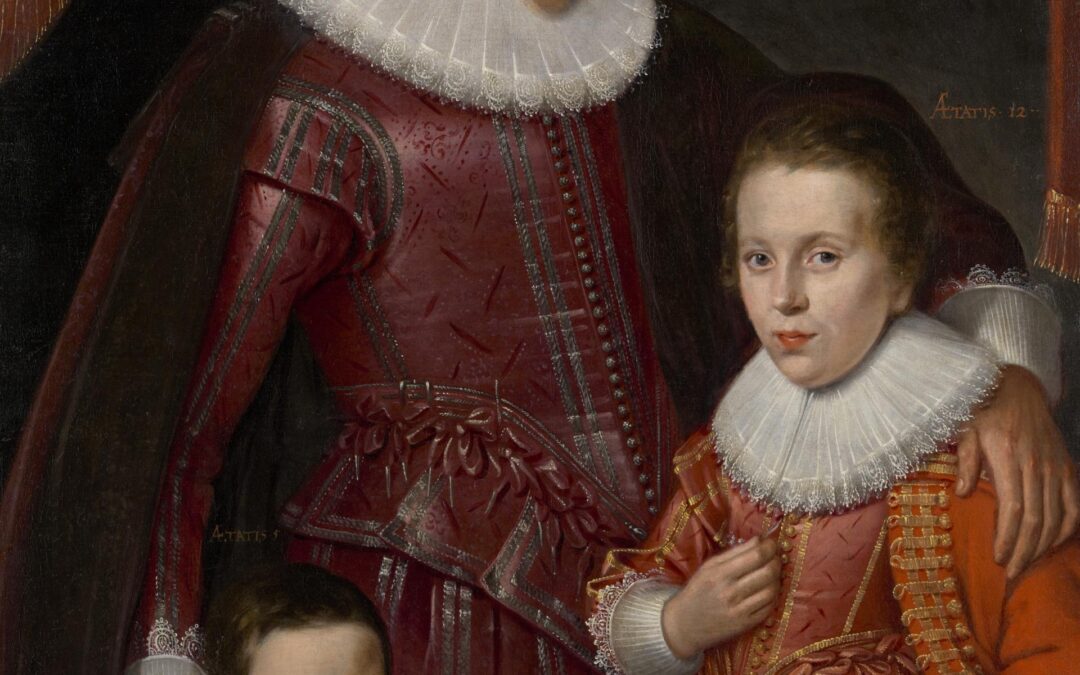
George Seton, Eighth Lord Seton and Third Earl of Winton with his sons by Adam de Colone. Image courtesy of the National Museums of Scotland.
Ernest Thompson Seton was a descendant of George, Eighth Lord Seton and Third Earl of Winton, subject of a painting by Adam de Colone.
Party Time
According to family records compiled by Karen Hancock, this George (1584-1650) “lived honorably, and kept a great house at Seton [Seton Palace], where he entertained King James VI [son of Mary, Queen of Scots], and his whole court in 1617, and King Charles I [second son of James VI] with all his retinue, both Scots and English, twice in 1633.” (Pg. 223 Seton, Earls of Winton) A devout Catholic and Royalist, he found himself in trouble during the time of Oliver Cromwell, but that came well after the date of this c. 1625 painting.
[This George was the grandson of George Fifth Lord Seton, protector of Mary Queen of Scots, and son of Robert Seton. The earlier George and Robert took part in the Battle of Langside.]
Patronage
The history of art patronage is inseparable from the art itself. Another way to put this is that someone must pay the bill for the artist’s time and materials. For Ernest Thompson Seton, payment came from work-for-hire commissions for books and magazines, or as part of the overall package for his own authored and illustrated books.
Adam de Colone was an up-and-coming portraitist when he had the good fortune to enlist George Seton as his patron. Colone was in his early thirties at the time this painting was created; records indicate that additional commissions came along over several years.
There is no direct comparison between the value of the 2026 dollar and the 1625 English pound. But, attempting an approximate comparison, the £40 paid by Seton for just one Colone painting was enough money to provide a year of high living for the artist. If Colone made occasional such sales, he became a wealthy man by the standards of that time. Seton must have had access to great wealth to pay for such art extravagance. The tailors of High Street (“Royal Mile”) must have eagerly anticipated his arrival, purchasing as he did the finest of clothes.
My Two Sons
The middle-aged Seton stands regally beside his two sons, with a protective (and affectionate?) hand on the shoulder of each. Maybe it was a premonition. The older son, George (“Lord Seton, Master of Winton,” 1613-1648) would follow the family tradition of taking the losing side in a war (the “English Civil War”).
Imprisoned by the supporters of Oliver Cromwell, George had to sell much of the family properties to ransom his son from imprisonment. The younger George returned to Seton Castle but died before his father. He likely contracted in prison a long-term debilitating disease such as “Consumption” (Tuberculosis).
The younger son, Alexander (1620-1691), also managed to get himself in trouble, at one point going into exile in France, and at another, fighting Cromwell. He maintained favor with the Royalists and became close to King Charles II. He did not end up with a Seton title but was awarded a different lordship—First Viscount of Kingston. He was predeceased by most of his multitude of brothers and sisters.
The Never Ending Story
A son of Alexander’s late brother became George, Fourth Earl of Winton. This George (b. ca. 1640) would serve in combat in service of the French army, and later, as a prevy counselor to Charles II.
The centuries long military and political record of the Setons continues to amaze.