
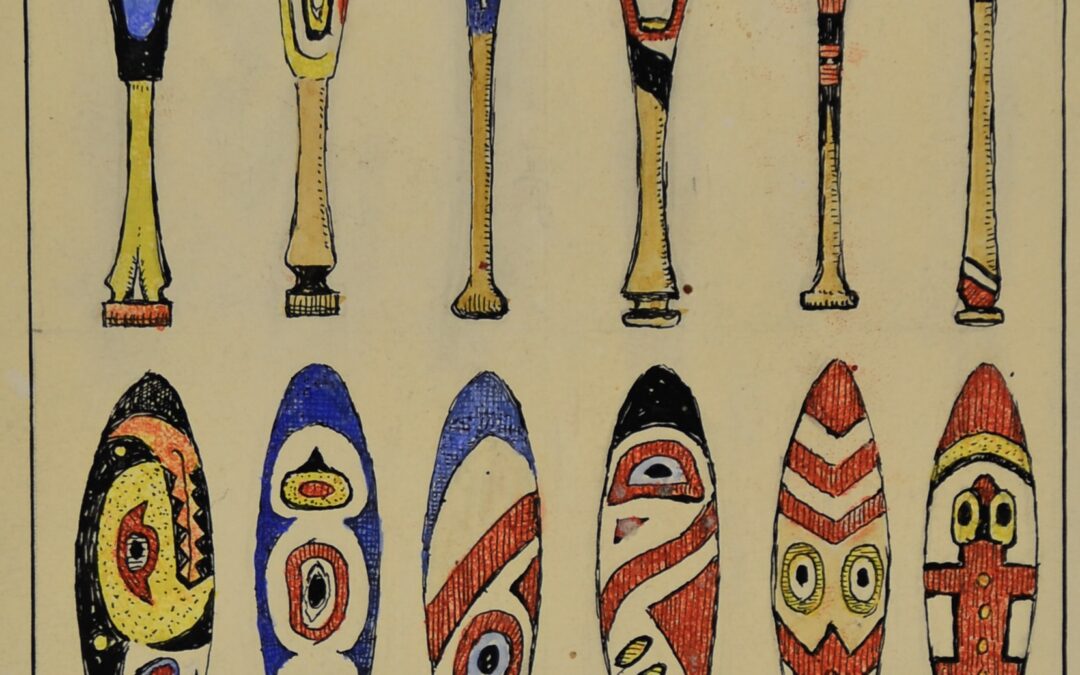
Painted Paddles by Ernest Thompson Seton, ca. 1930s, Academy of the Love of Learning. All image rights reserved.
Ernest Thompson Seton collected pottery, baskets, and similar materials from many Native American tribes; recently, some of those items have been returned. (By chance, I am writing this on the October 23 anniversary of Seton’s passing.)
Seton Collection of Native Art
Seton began taking a focused interest in Native American cultures by the late 1890s. Soon afterward, he began collecting various cultural items. His collecting accelerated when he made regular trips to New Mexico in 1927 and then took up residence there three years later.
Most of these were purchased directly from the makers or received as gifts; others were acquired from art dealers. By the time of his death in 1946, he had put together several hundred items from at least three dozen tribes.
Decades after his passing, his family gifted most of the collection to the Boy Scouts of America. Those items are housed at the National Scouting Museum at Philmont Scout Ranch in New Mexico. (I cataloged that collection during the summers of 1972 to 1974.)
A smaller collection remained with the Seton family. In 2003, the Academy for the Love of Learning purchased Seton’s Santa Fe, New Mexico home along with its contents. This included Seton’s paintings and drawings and the remaining Indigenous-created materials.
The “artifacts” came with almost no supporting documentation. (Much more about that term—and its misuse—in an accompanying blog.) We decided not to show them. Our knowledge was limited, and we suspected some could be culturally sensitive. We did, however, show Seton drawings copied from, or inspired by, the Native American art collection he put together. Painted Paddles is a sample of that use.
Rematriation
Museums (and educational institutions such as the Academy for the Love of Learning) have both a legal and ethical responsibility for the care of their collections. This can include ending stewardship by finding a more appropriate home. This has been termed an “ethical return,” but also “Rematriation.”
Rematriation assumes that an individual person, often female, created something of value, a value which has come down to us over time. From this follows that the owner of this thing of value has an ethical obligation to reconsider continuing its stewardship. (The term has been around for some time and can refer to issues of land ownership. Here it specifically refers to the Seton collection at the Academy for the Love of Learning.)
I was introduced to this term at a meeting of Academy staff with a group of tribal elders. This led to a re-evaluation of our stewardship of fifty-five indigenous-created items including baskets, pottery, textiles, and musical instruments.
Like other Anglo artists of his time in New Mexico, Seton pursued collecting partly out of ethnographic interest, but also because using these items supported his promotion of the Woodcraft ideal. Seton and family cared for the collection until it came to the Academy.
Return to Home
We entered a years-long process, recognizing that the destiny of the items in our collection lay elsewhere than with us. All the items needed to return home, but where to start? We had to identify each item by tribal origin. We had to develop a legal framework for transferring ownership title. We also had to find the right person within each tribe to contact. The Academy hired two people to make it all happen.
Laura Eliff Cruz (Choctaw Nation of Oklahoma) is the head collections manager at the School for Advanced Research in Santa Fe. Ash Boydston-Schmidt (Apsáalooke, descendant of the Crow Tribe of Montana) is the NAGPRA Coordinator at the University of New Mexico Maxwell Museum in Albuquerque. Their professional and personal dedication to the process of Rematriation has led to the return-to-home of the Seton collection to the tribes of origin.
They have made the Academy for the Love of Learning a national leader in the Rematriation movement.
To be continued in Part II of this series.