
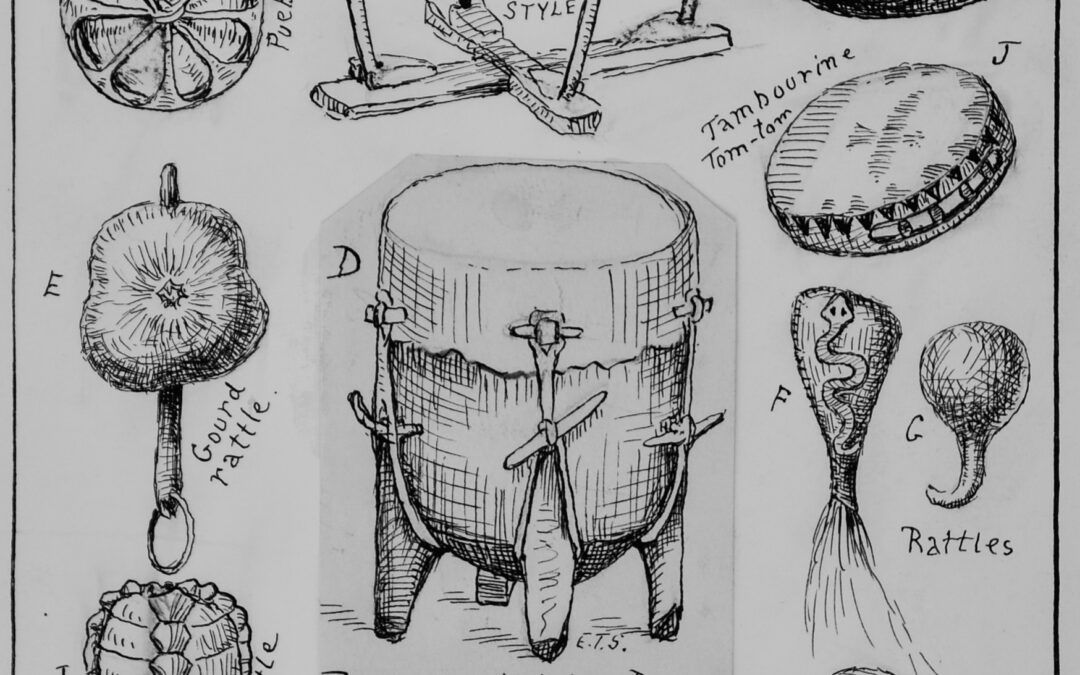
Drums by Ernest Thompson Seton, ca. 1930s, Academy of the Love of Learning. All image rights reserved.
Rematriation describes the ethical return of land and physical items to their home communities, but it can also apply to words.
The words we choose can enhance our misunderstanding
In Part I of this series, I discussed returning Indigenous items from the Academy for the Love of Learning’s collection to their tribes of origin. This important process has led to acknowledging the presence of questions about the words we used in the past to describe Indigenous collections. Meanings change depending on which ones we choose.
Artifact
Let’s start with a common term: Artifact. I used that term over the six decades of my museum career—without giving it adequate attention. I looked up the definition: Artifact: “an object typically of cultural or historical interest.” It is a “physical item left behind by past people.”
This seems reasonable enough: Until you start parsing it out.
To begin with: the artifact is “of cultural or historical interest” to whom and for what purpose? In this case, let us say it is me, an outsider peering into someone else’s history and culture. Is an item that is only an “Artifact” meaningful to me or to anyone else?
Even more problematic is the claim that “it was left behind by a past people.” But what if those who made the artifact, a so-called “past people,” are still here?
Under those circumstances, is it still an artifact, or something else?
Left Behind
What about the phrase, claiming the object has been “left behind?” This could mean looted from a sacred site, purchased from an unwilling seller, or abandoned or lost for an unknown or unremembered reason, intentionally or unintentionally.
It was likely meant to remain where someone put it; whoever originally made it could not have imagined it ending up in a museum. Especially not enclosed in boxes never to see the light nor feel the air again from its resting place in the museum collections room.
Unknown Artist
Now, let’s say I identify this left-behind Artifact as being by an “unknown artist.” Unknown to whom? Maybe to me. But the maker was certainly known to the people for whom she created the basket or the pot.
Some years ago, on a visit to the Heard Museum in Phoenix, I saw that the identity designation for this unknown person has evolved into “Artist Once Known.” The difference is more important than it might at first seem. “Once Known” conveys a sense of individual personhood that “Unknown” cannot achieve.
Creation
What happens when an artifact becomes a Creation and an unknown artist becomes an Artist Once Known? We must acknowledge the basket, pottery, or textile as having been made for a specific purpose by a living person; then our understanding of it changes, even if we don’t know their intention or name. By using the correct word, we can establish a more meaningful connection to something and to someone who came before.
While an artifact is no more than a thing, a Creation may be seen as something with a destiny. And if so, what is our responsibility to this or to these Creations? This is less a collections management issue than an ethical one.