
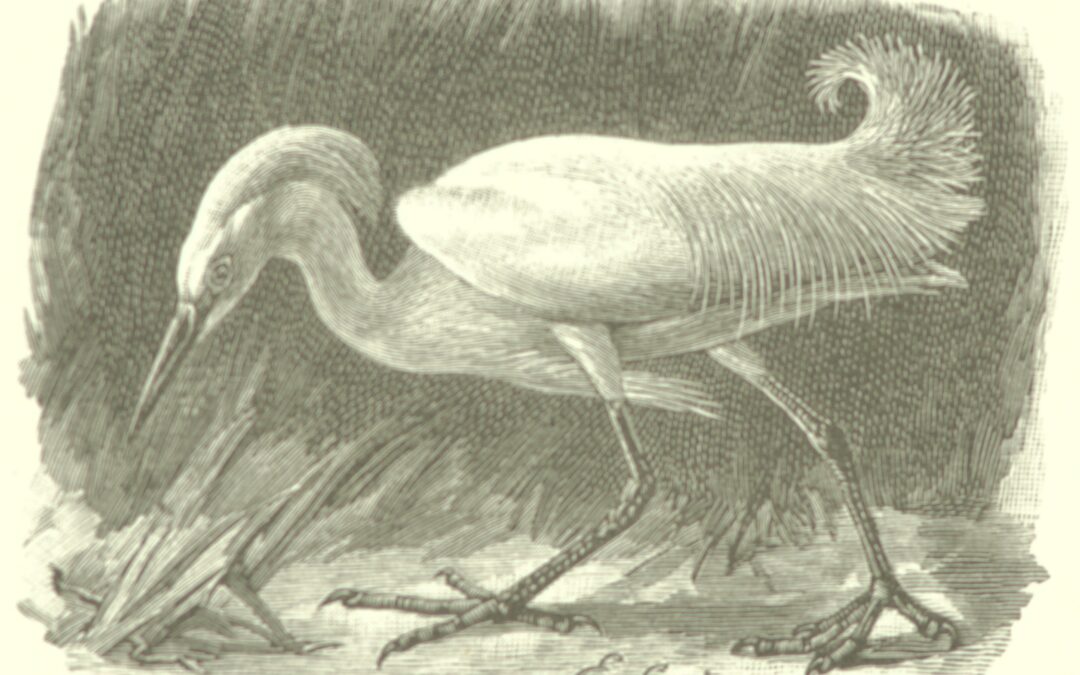
Snowy Egret by Ernest Thompson Seton, ca. 1880s. Academy for the Love of Learning. All Image rights reserved.
Ernest Thompson Seton became a leading advocate for wildlife conservation, joining the movement to protect egrets. In 1913, he made a critical contribution to wildlife conservation.
The Bird Back Story
According to Paul Tritaik, writing for Conservation History (Vol. IV, No. 1, 2020, U.S. Fish & Wildlife Service), two cousins in 1896 Boston began reading about “the slaughter of beautiful egrets in Florida by plume hunters.” At the time, ladies’ hats were decorated with the feathers of these birds—unfathomably huge numbers of feathers that led to a near-extinction event for these wonderful creatures. By 1886, egret feathers sold for $32 per ounce. The approximate equivalent in 2026 is $1292.00.
Harriet Hemenway and Minna B. Hall could have made a personal statement by giving up egret feather decorations. But they went further, organizing hundreds of women to oppose the feather madness. That same year, they founded the Massachusetts Audubon Society for the Protection of Birds, a model that spread nationwide. (“Mass Audubon” still exists.) An environmental cascade followed.
Perhaps the cousins had become familiar with W.E.D. Scott’s research, which warned about this bird disaster in an 1887 issue of The Auk, a publication of the American Ornithologists’ Union. (Seton later wrote for this journal.)
A Chronology of Environmental Action
1884 Seton joins the newly formed American Ornithologists’ Union.
1887, Vol. 4, The Auk (the journal of the AOU). W.E.D. Scott warns the scientific community (and beyond) about the egret slaughter.
March 1900. Seton makes a highly public call for wildlife conservation, bringing the issue to national attention in The Century Magazine: “The National Zoo at Washington: A Study of its Animals in Relation to Their Natural Environment.”
May 1900. “The Lacey Act” restricts interstate trade in illegally sourced birds. Sponsored by conservation hero Rep. John F. Lacey (Republican, Iowa; member of the Boone and Crockett Club; ally of Theodore Roosevelt). Signed by President William McKinley.
March 1903. President Theodore Roosevelt establishes the U.S. National Wildlife Refuge system by designating Pelican Island in Florida as a federal bird sanctuary.
June 1906. President Roosevelt signs the “Antiquities Act,” giving the President authority to preserve Federal lands of cultural and conservation importance without congressional approval. Sponsored by John F. Lacey.
Weeks—McLean
May 1913. The “Weeks-McLean Law,” becomes an essential milestone of the wildlife conservation movement.
It didn’t come easily.
This legislation was needed after the Lacy Act proved less effective at saving egrets and other birds than initially hoped. The bill funded the Division of the Biological Survey, a precursor to the United States Fish and Wildlife Service and granted the government regulatory authority over many bird species. If Republican senators who held it up suspected it might lead to a greater-than-expected expansion of federal power, they were correct.
Henry Ford, a registered Republican at the time, an amateur ornithologist, and an ardent bird conservationist, supported Weeks-McLean. (When not birdwatching, Ford manufactured automobiles.) He enlisted his close friend, the revered writer-naturalist John Burroughs, to help pass the bill; nonetheless, it seemed destined to fail.
Seton Rescues Weeks-McLean
This story is mostly unknown to the environmentalist community:
Glen Buck, the editor of the Ford Times (sort of a Reader’s Digest + car-sales magazine owned by Henry) was tasked with getting the bill approved. Buck contacted the one person needed to seal the deal: Seton. I don’t know if Buck knew Seton, but Buck knew Burroughs and knew how important Weeks-McLean was to his boss. He suggested that Seton and Burroughs do some citizen lobbying, meeting with the two recalcitrant Senators.
The meeting took place. According to Seton, he did most of the talking while John of the Birds awed the politicians by his mere presence. Burroughs was one of the most honored and respected men in the country. The two of them made a persuasive team. They won over the Senators and the bill passed, becoming a major milestone of the conservation movement.
Also, an unconstitutional one; it didn’t pass muster with the Supreme Court. But no matter, bird conservation became a national priority.
A Continuing Saga
August—September 1916. The Migratory Bird Treaty between the U.S. and Great Britain (acting as agent for Canada) is ratified by the Senate and then signed by President Wilson. (This replaced Weeks-McLean.)
July 1918. President Wilson signs the Passage Act, implementing the Migratory Bird Treaty. (The final version included Japan and Russia.)
Another descendant of Weeks-McLean was the Endangered Species Act of 1973.
The Situation of Egrets Today
The Snowy Egret (Egretta thula) survived the fashionista slaughter; their population eventually recovered. Habitat loss and pesticides threaten this magnificent creature today.