
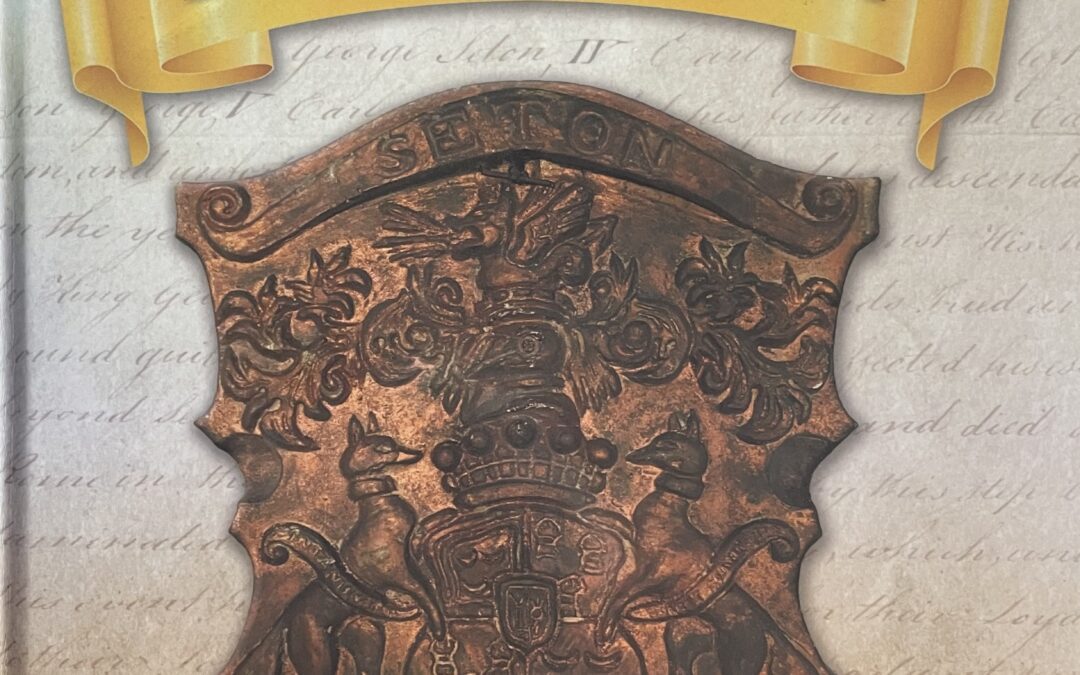
Cover art, Seton Earls of Winton (2015)
George Seton, “The Saddler” (1796-1853) hoped to become Lord Seton, Sixth Earl of Winton. Ernest Thompson Seton’s great grandmother Ann was George’s auntie.
Seton (that is, E.T.) had this to say about his ancestry in Trail of an Artist-Naturalist (1940):
“In the north or England…is the famous river Tyne…This was the home of my people, although nearly all were of Scottish origin. They had fled from Scotland after risking all and losing all in the Stuart Rebellion of 1745. Most were hiding under assumed names….” Pg. 3
This included his great-grandfather Alan Cameron, who, having escaped the disaster at the Battle of Culloden, took the name of Thompson. More important for this story is George Seton:
“In the earlier rising [the Jacobite rebellion of 1715], our great-grandfather [sic], Lord Seton, the Earl of Winton, had taken part, and lost everything…His only grandson, and his lawful heir, was George Seton, of Bellingham, Northumberland, my father’s first cousin.” Pg. 391
The Balies Of Cannongate
George attempted to claim the title of Earl for himself, perhaps to lay claim to what had been family properties. The Balies of Cannongate [a court in Edinburgh] “acknowledged the validity of the claim, and George Seton was served with the Earl of Winton…he named my father [Joseph Logan Thompson] as his heir and lawful successor to the title, as he was the only male survivor of the line.
On her deathbed, Ann reputedly, “in these, her last words, enjoined him: “Never forget, Joseph, you are the heir.” Pg. 392
Joseph must have been a precocious toddler to take all that in! In the event, he had a different take on her last words, if last they were. Neither Joseph nor Ernest seemed to be aware of the Walker family—more direct descendants of Fifth Earl who had the stronger claim. Had there been anything to claim.
Chimeras Anyone?
But there was nothing to claim. The title of Earl of Winton had died along with the Fifth Earl. Which brings us back to the disappointment of George who wanted the title reinstated in 1825, but to do so he had to bring a petition before the court.
And all this just about exhausted my knowledge of the matter. Until I found Seton, Earls of Winton (2015), a self-published book by enthusiastic descendants who happened to own the original court records. “The collection of these documents is now available for all generations.” I cannot begin to tell you how rare it is for so much original documentation to become so easily available. ($55.00 from Amazon!)
Remember The Preston!
George Seton, Fourth Earl of Winton, died in 1704. His son, George Seton was eventually confirmed as the Fifth Earl of Winton, and as it turns out, the final one. By the time of his father’s death he had been knocking around Europe, perhaps as a kind of eighteenth-century Eurotrash. He got around to claiming his paternal rights and the family castle a few years later, settling in to do whatever it was that the gentry of that time did.
As was typical for Setons, he supported the losing side, in this case the Jacobite rising of 1715. After the opposing faction broke into his house and made of mess of it, George joined the Stuart forces. After some initial encouraging results in Scotland, the Jacobite leadership decided to invade England—against the advice of George. The Battle of Preston proved George correct; the Stuart forces made a muddle of it, and so the rebellion ended.
For his trouble, George was arrested and given what must have been uncomfortable quarters in the Tower of London. Not long before his intended execution—in August 1716—he somehow escaped by sawing through the bars of his prison cell with a watch spring. Perhaps using a precursor to the “Graff Diamonds Hallucination.” I am inclined to doubt this family story. However, one can easily imagine that he used his watch to bribe a guard to let him out. As with the death of Jeffrey Epstein, there were no security cameras operating at the pivotal moment.
The Fountains Of Rome
George found his way to Rome where he lived for several decades, expiring in 1749. As punishment for taking the wrong side, his Earldom was extinguished. For six hundred years the Setons had taken leading roles in the affairs on Scotland and been rewarded with titles of Lord and Earl, among others.
But now it was over.
Or not.
To be continued in Part II.