
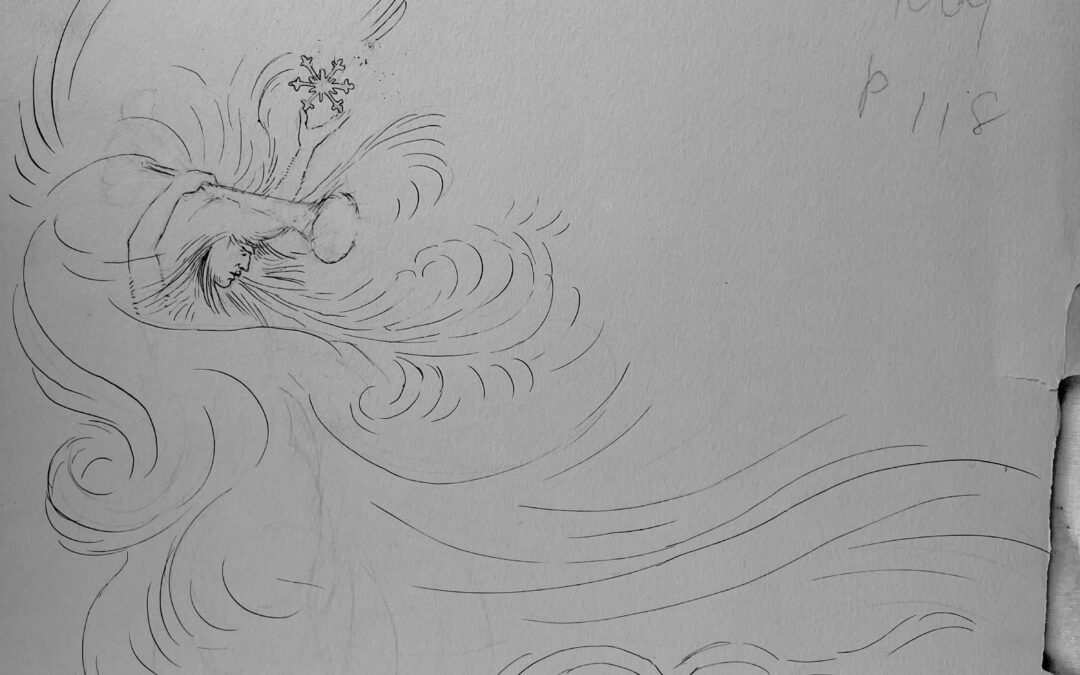
Untitled Wind Spirit. Academy for the Love of Learning. All Image rights reserved. Ernest Thompson Seton created a drawing to illustrate a prose poem about the winter White Wind.
ALL #0968 Pen and ink on paper. 35.3 x 25.7 cm. ca. 1900. Most likely created in one of Seton’s studios in New York City or Cos Cob, Connecticut. Head of a spirit person with horn, lines of wind, snowflake. Publication: Lives of the Hunted, pg. 102 in the first edition a story entitled: “Krag, The Kootenay Ram.”
An Important Drawing
The drawing at first may seem unremarkable with the head of the mothering wind nearly obscured by all the commotion surrounding her. And yet, it may be second only to “The Thought” drawing in importance. (“The Thought” original is not in the Academy collection so I will get back to it in another essay.)
“Lobo, King of Currumpaw,” was the first wildlife story in which the wolf was the hero and the human hunter (Seton), the villain. In the Krag story, Seton creates the modern environmentalist story. Scotty MacDougall, the remorseless hunter of Big Horn Sheep, is a kind of stand-in for the human destructiveness.
A small step for a man, a giant leap for mankind
Which is to say, a step into the abyss. The Krag story is unapologetically allegorical. We can, as a species claim for ourselves the power to destroy everything. Maybe one species at a time. Maybe one country at a time. Maybe one accepted lie at a time. It is up to us to misuse our vast power in any way we choose. According to Seton, the conquest and defeat of nature, of beauty, of morality leads us in one direction only. Seton termed this The Thought, about which, much more elsewhere on this site.
In this case, the Big Horn hunter has achieved his murderous goal—but at the price of his soul. An unamused Mother Nature gets the last word over the sinister Scotty and over the rest of us as well. (By chance, as I was writing this, I happened to be listening to the dark “Adar Suite” from The Rings of Power, Bear McCleary, composer)
Excerpt from Krag, Pg. 102—103
“The White Wind rose high that night, and hissed and wailed about Scotty’s shanty. Ordinarily the stranger might not have noticed it; but once or twice there came in over the door a long snoof that jarred the latch and rustled violently the drapery of the head. Scotty glanced at his friend with a wild, scared look. No need for a word; the stranger’s face was white.
In the morning it was snowing, but the stranger went his way. Wind blew, and the snow came down harder and harder. Deeper and deeper it piled on everything. All the smaller peaks were rounded off with snow, and all the hollows of the higher ridges levelled. Still it came down, not drifting, but piling up, heavy, soft, adhesive—all day long, deeper, heavier, rounder. As night came on, the Chinook blew yet harder. It skipped from peak to peak like a living thing—no puff of air, but a living thing, as Greek and Indian both alike have taught, a being who creates, then loves and guards its own. It came like a mighty goddess, like an angry angel with a bugle-horn, with a dreadful message from the far-off western sea—message of war; for it sang a wild, triumphant battle-song, and the strain of the song was:
I am the mothering White Wind;
This is my hour of might.
The hills and the snow are my children;
My service they do to-night.”
All is lost; is anything learned?
“And here and there, at the word received, there were mighty doings among the peaks. Here new effects were carven with a stroke; here lakes were made or unmade; here messengers of life and death despatched. avalanche from Purcell’s Peak went down to gash the sides and show long veins of gold; another hurried, by the White Wind sent, to block a stream and turn its wasted waters to a thirsty land—a messenger of mercy.
But down the Gunder Peak there whirled a monstrous mass, charged with a mission of revenge. Down, down, down, loud snoofing as it went, and sliding on from shoulder, ledge, and long incline, now wiping out a forest that would bar its path, then crashing, leaping, rolling, smashing over cliff and steep descent, still gaining as it sped. Down, down, faster, fiercer, in one fell and fearful rush, and Scotty’s shanty, in its track, with all that it contained, was crushed and swiftly blotted out. The hunter had forefelt his doom. The Ram’s own Mother White Wind, from the western sea, had come—had long delayed, but still had come at last.”