
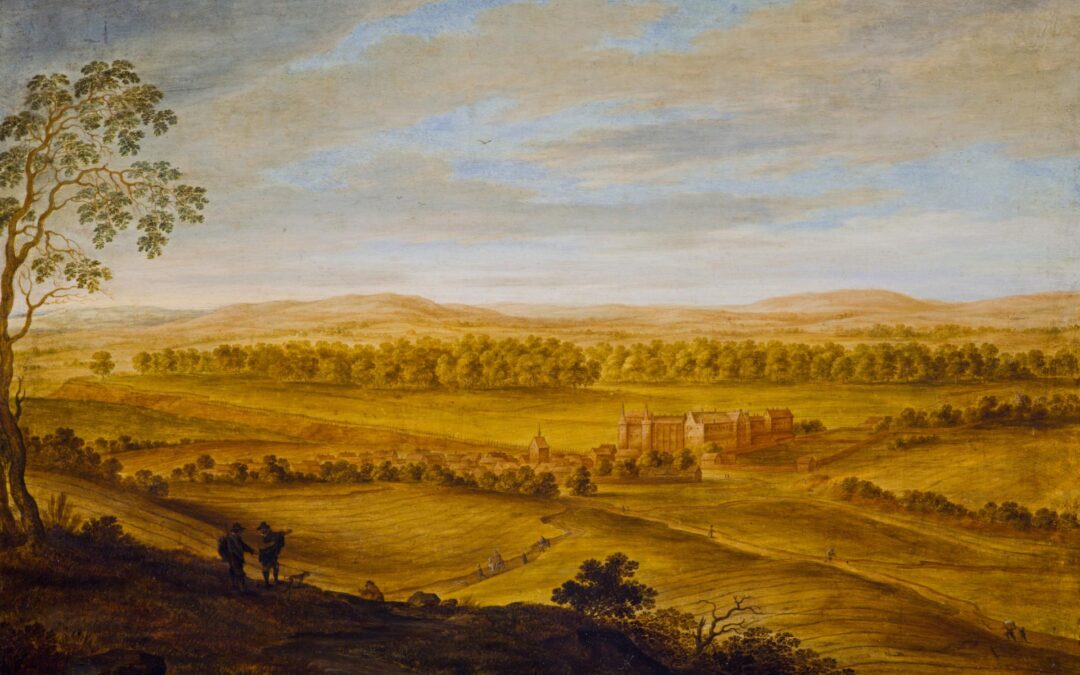
Seton Palace and the Forth Estuary by Alexander Keirincx. Image courtesy of the National Galleries of Scotland.
Seton Palace, located east of Edinburgh, Scotland, was one of the most important buildings of its kind in the seventeenth century.
Two Artists, One View
According to the records of the National Galleries of Scotland, this 1639 painting was based on drawings made by the draughtsman Adriaen van Stelbemt six years earlier during a visit with Charles I. Keirincx and Stelbemt were both Flemish, appropriate given the likely Flemish origins of the Seton family.
Two Or Three Castles
The land on which the Palace was built had been acquired by Christopher Seton, brother-in-law and close ally to Robert the Bruce, probably at the beginning of the fourteenth century. Whether or not this Christopher (there were several Christopher Setons) had architectural ambitions is not known as the English executed him in 1306.
At some unspecified time a castle was built on the site, and like Christopher, was subsequently destroyed by the English.* The Palace depicted in Keirincx’s painting came into being after 1544. Mary Queen of Scots and George Fifth Lord Seton favored it as a royal hang out. Mary is said to have played golf there. (I have uncovered no information about her handicap as a golfer.)
The Palace was likely a pleasant enough place until it was partially razed in 1715 by rowdy gents who had some beef or other with George Seton who lived there at the time. (No word on whether he played golf.) The Seton-Wintons also owned nearby Winton Castle (built in 1480), but both buildings became run down after this time.
The View From 1723 to 1790
John Macky in Journey through Scotland (1723) described the state of the deteriorating buildings before adding this about the family:
“The family of the Seatons [Setons] is one of the noblest families in the kingdom, there being few families of any antiquity but are either come of them, or are allied to them. They were great opposers of the Reformation, and all revolutions since. They always lean on the Popish side, although almost all of them profess themselves Protestants. They are also very ancient.”
Which it to say that all of Scotland’s major gentry families (as well as some in England) were related to, allied with, or descended from the Twelfth Century Seton-Wintons.
Seton Palace deteriorated beyond repair and was torn down in 1790. One long section of its walls remains today. Adjacent to the original site, a new building, called Seton Castle, was constructed and maintained well enough to now be considered an architectural treasure of Scotland.
A Bucolic Scene
It seems likely that Keirincx didn’t see East Lothian in person. If that is the case, then he had only Stelbemt’s sketches and his imagination to work from. The art historical way to put this is that there is more poetry than realism in the scene. It appears to have yellowed from age (due to chemical changes in the varnish) so I suspect that it was more vibrant when first painted.
Nonetheless, it is a masterpiece of period landscape painting, showing the massive Palace growing like a crop of stone out of the wheat fields. Even after its abandonment, the Palace’s remaining walls topped forty feet so that it was, by the standards of the time, a substantial structure. The copse of low trees mostly hides the attending village on the left. A line of remnant forest creates a barrier between the building and the moors beyond, nicely framing the entire scene.
Except for three persons and a dog on the overlooking ridge, the diminutive people add a sense of scale, but we don’t learn much about them. The two men on the ridge are the only animating feature in the otherwise lazy day scene. Real estate developers?
*For centuries, destroying Castles was a fun pastime for the English and Scottish militaries.