
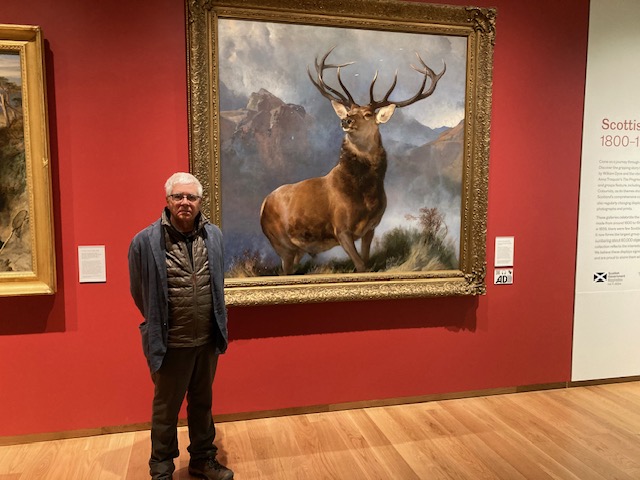
Art Historian with Monarch painting
Monarch of the Glen, the famous painting of a Red Deer by Edward Landseer, influenced the art of Ernest Thompson Seton. One of the great treasures of Scotland’s National Galleries in the capital of Edinburgh, in person, the portrait of this magnificent Highlands creature, lives up to expectations.
Single Malt Wildlife
Painted in the decade before Seton was born, this large work later provided a model for Seton. I don’t know when he may have first seen an image of it, but Monarch has been widely reproduced on everything from inexpensive reproductions to whisky bottles (In Scotland, the name of this beverage is spelled without the “ey” ending more familiar to Americans.)
Compositionally, the painting is a masterwork with the Deer placed to dramatic effect. Following the upward slope of the Deer’s back (left), notice that the line of it continues with the mountain slope (right). The many points of the magnificent antlers are suggestive of the many craggy peaks in the background. The power of the storm is reflected in the strength shown in the muscular shape of the animal, etc.
Art of the Portrait
Note the three-quarter view of the Deer’s face. In addition to being anatomically correct (as far as I know), the importance of the painting comes in part from its being a portrait. Angled at a three-quarters view, the haughty, self-empowered, imperious animal looks not at us but outward to the domain which it oversees. This is the portrait of an individual (even if an idealized one) whose thoughts and life accomplishments and pride are every bit as real to him as ours are to us.
In Seton’s finest works, such as The Sleeping Wolf, we get the same impression of an animal not as generic representative, but as an individual. Wildlife art as portrait.