
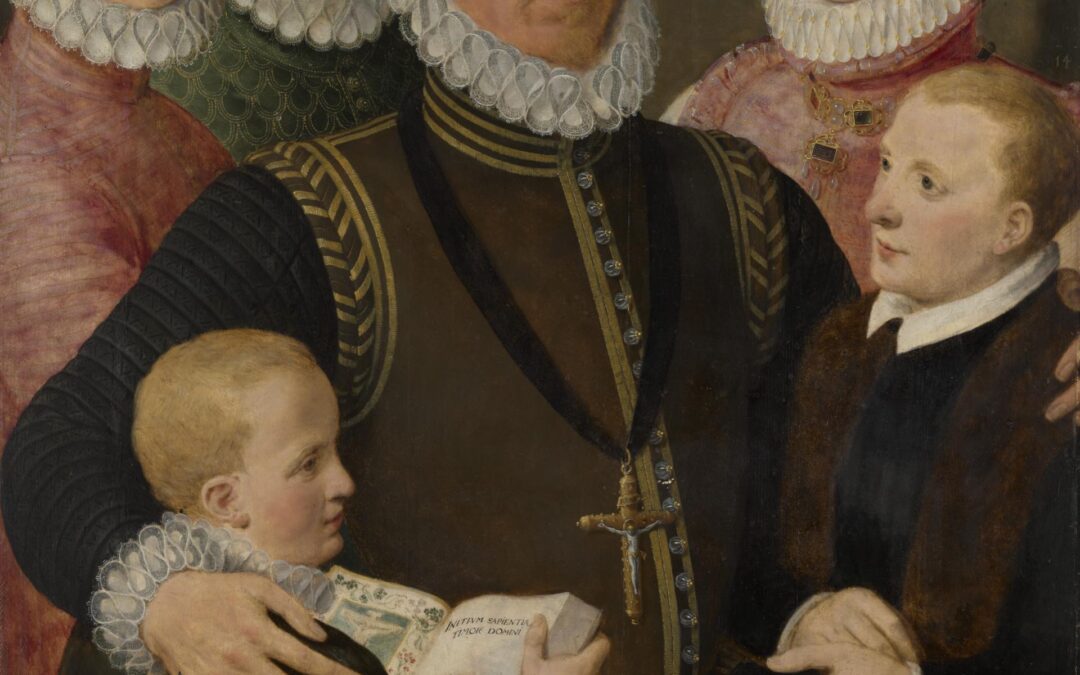
George, Fifth Lord Seton and his family by Frans Pourbus the Elder. Image courtesy of the National Museums of Scotland
Ernest Thompson Seton’s ancestor George Seton, surrounded by his family sat for a portrait in 1572. George Seton had survived the Battle of Langside to raise his five children who forged distinguished careers of their own.
Hazard, Yet Forward
When we last left this George Seton (one of many George Setons), he had survived the Battle of Langside. He remained in the good graces of the English King James VI despite continually plotting in favor of James’ mom, Mary Queen of Scots.
At the time of this portrait, George and his family were in the Netherlands representing the interests of Mary. He was attempting to recruit the Spanish Duke of Alba, governor of the Netherlands, to hop over the England with his soldiers to help Mary in her political career. Unfortunately, the Duke was then engaged in slaughtering locals to maintain Spanish control over that territory. (He was by title, “The Most Excellent Fernando Alverez de Toledo Third Duke of Alba.”) As a result, the Duke took no part in Scottish issues. (The “Eighty Years’ War” ended with Spain giving up in 1648.)
Frans Pourbus the Elder
While not trying to stir up trouble, George found time to pose for this magnificent portrait, an outstanding painting featured in the portrait gallery of the National Museums of Scotland.
What do we see?
George’s outward gaze is that of a self-confident and determined man, a survivor of more than one life-threatening crisis, risk taker and cautious at the same time. Like the Seton’s before him who put their lives on the line to fight with Wallace and Robert the Bruce, this man is anything but fainthearted.
His financial fortunes went up and down, but at the time of this portrait, he seems to have been more than a little prosperous. The hat jewels, the two finger rings, the linen ruffs (did they take them off at mealtime?) give him the air of authority needed to represent Mary’s interests in Europe. (The artist maintained a studio in Antwerp, so that is the likely place where it was painted, working from graphic sketches.)
George is a deeply religious Catholic, one of the few of the Catholic aristocracy not forced to convert to Protestantism—or killed for not doing so. The silver Jesus on the golden cross, resting just below the breastbone is not to be missed. The Bible held by the boy is inscribed: Initium Sapientia timor domini (The beginning of wisdom is the fear of the Lord: Proverbs 9:10.) He has had the artist include a special admonition to his daughter in the space between their faces: My daughter, fear God and honor Him, for the honor of the soul is tender and delicate.
The Kids Are More Than Alright
Unusual for the period, five of George’s six children reached adulthood.
Left to Right, Top:
John Seton, age 18, later Sir John Seton of Barns, diplomat, Court of King Phillip II of Spain.
Robert Seton, age 19, later First Earl of Winton and Sixth Lord Seton.
Margaret Seton age 15, later maternal ancestor of the Dukes of Abercorn.
Left to Right, Bottom: (My best guess from contradictory sources)
Sir William Seton, age, ca. 9?, later chief border magistrate, Scottish-English border.
Alexander Seton, age 14, later First Earl of Dunfermline, and Lord Chancellor of Scotland.
A Family to be Reckoned With
Compared to other Scots heroes such as Rob Roy MacGregor, the Seton’s are not much remembered. Ernest Thompson Seton, among the top selling authors in English (if we include his fathering of the never-ending Boy Scout manual), co-founder of Scouting and (through wildlife conservation), two of the great Twentieth Century social movements, has been similarly neglected by history. Not as colorful as Rob? Like Ernest, from the time of the first Twelfth Century Setons, the family has become so much a part of the foundation of history that they disappear into it even as they define and guide it.
Netherlandish Painting
Like other Flemish and Dutch painters of the Sixteenth Century, Pourbus studied Italian Renaissance paintings at just the right time, becoming an early advocate for the often-moody realism they favored. The “Netherlandish” painters were ready to cater to the newly affluent merchant class, as well as old money gentry such as George Seton. The successful ones received vanity portrait commissions from wealthy ladies and gentleman.
They also discovered something more interesting: family group portraits. Here we see George as a successful man of the world, as the patriarch of a family that very much has its eyes on the future—and projecting the idea of that power into the future.