
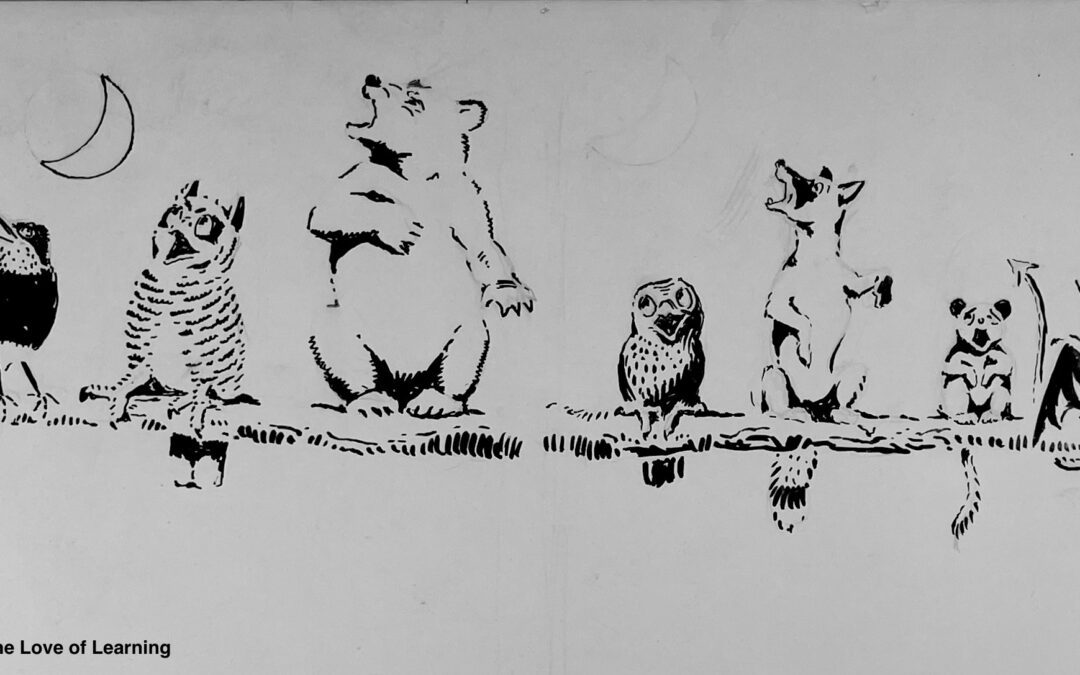
Untitled Singing Animals by Ernest Thompson Seton. Academy for the Love of Learning. All Image rights reserved.
ALL #0976 Pen and Ink on paper. 25.8 x 35.6 cm. ca. 1904. Most likely created in one of Seton’s studios in New York City or Cos Cob, Connecticut.
This drawing appears above the Table of Contents in Woodmyth and Fable, published April 1905 by The De Vinne Press and dedicated to Seton’s daughter: “To Little Ann.” Here, in this most whimsical of all Seton’s books, the animals are the “singers” in the Homerian sense—the tellers of the tales. By my count, there are fifty-one of these included in this short book.
The tales are told as stories or in verse. Many are followed by morals:
“The only danger of a sunken rock is that it is not sunk deep enough.”
“When the top is wider than the root, the tree goes down.”
“A Bull can paw more earth than an Ant, but leaves no monument.”
Here are four examples:
Comfort
Sheet-lightning is for Summer heat,
It never strikes the ground;
Chain-lightning comes with danger fleet
And thunder’s awful sound.
But prithee be not troubled,
It need not cause you fear:
The thunderbolt that kills you
You will neither see nor hear.
A Recipe
When the Oak-leaf is the size of a
Squirrel’s foot, take a stick like a Crow’s
bill and make holes as big as a Coon’s
ear and as wide apart as Fox tracks.
Then plant your corn, that it may ripen
before the Chestnut splits and the Wood-
chuck begins his winter’s sleep.
Purple Finch
Why they should call him Purple Finch
I never yet could think;
And when I asked the bird its hue,
He clearly answered, “Pink.”
The Land-Crab
“I am absolutely unchangeable. Nothing can turn me aside one hair-breath from my purpose,” said the little Land-crab, as he left his winter quarters in the hills and began his regular spring journey to the Sea. But during the winter a line of telegraph poles had been placed along his track. The Land-crab came to the first pole. He could not turn aside one inch. He spent all day climbing up the side of the pole, and all the next day climbing down the other side, then on till he came to the next pole, where he had another frightful climb up and over and down again. Thus he went day after day, and when the summer was gone they found the body of the poor little Land-crab dead at the bottom of one of the poles only half-way to the Sea, which he might have reached easily in half a day had he been contented to deviate six inches from his usual line of travel.
MORAL: A good substitute for Wisdom has not yet been discovered.