
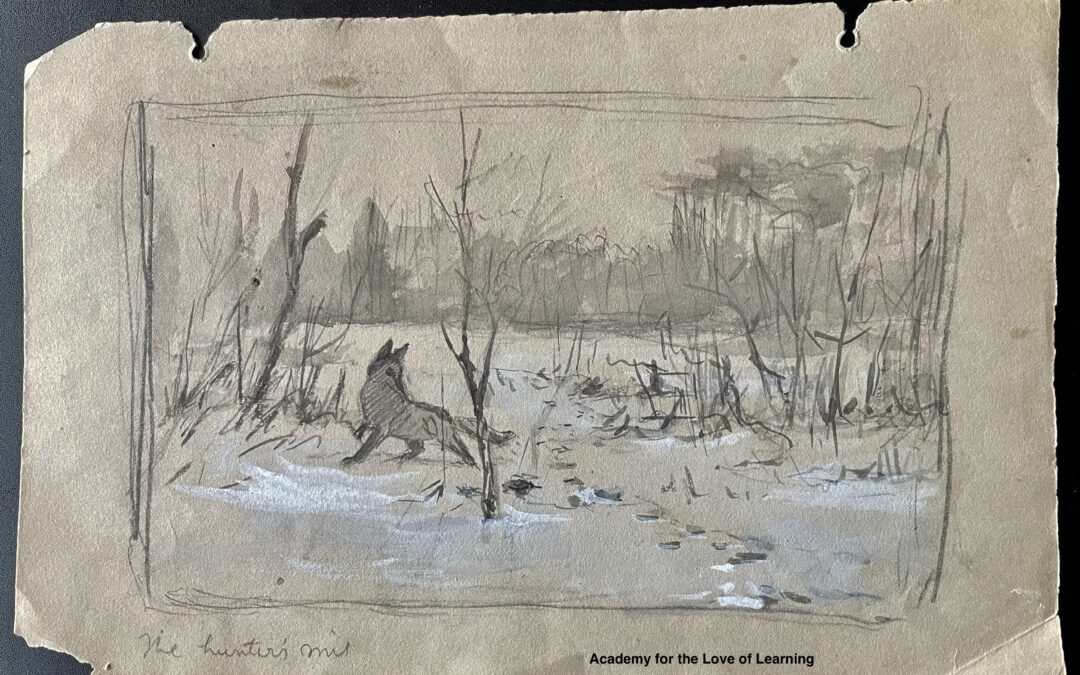
The hunter’s mit by Ernest Thompson Seton. Highlights of the Academy for the Love of Learning collection of Seton Drawings and Paintings/All image rights reserved.
ALL #0913. Ink and gouache on paper. 24.1 x 15.5 cm. Dated on back, 1886. Likely drawn while Seton still lived in Canada.
This one is especially interesting to me. Seton turned this sketch into a painting dated “after 1920” with a different title: “Fox and Mitten.” If the date for the painting is correct—and I believe that it is, and if the date for the sketch is correct, then he worked from decades-old material to create the finished piece. I assumed that the “1886” written on the back is a year, but if so, was it dated at the time of its creation or later when Seton wrote down what he remembered (or misremembered?) Or is the number “1886” something other than a date?
The drawing paper is certainly old, and very old if it is really from 140 years ago when I am writing this. Or maybe it is younger and the paper has deteriorated to make it look older than it is.
What’s In a Date
I am inclined to conclude that the 1886 date is correct. Call it a best guess because we will never know for sure. Comparing the two images, note the striking similarities right down to placement of tree branches, the fox with right front leg lifted, and the mitten itself.
The important difference is that all the foreground brush has been removed in the painted version—a good decision to get rid of the clutter to make the fox the central focus. If you didn’t already know the title, would you guess the identity of the item grabbing the attention of the passing fox? In the drawing it is located to the right of the spindly tree. Like us, the fox is wondering about the identity of the object.
Raymond Hall
The USDA database cites E. Raymond Hall (1902-1986) as an authority on the Red Fox from his massive The Mammals of North America (1959). I arranged to meet him at his lab at the University of Kansas back in the 1970s. I recall his pride in showing me his dead rodent collection, a major one from which “type specimens” are used as definitive examples of particular species. I likely asked him about Seton’s Lives of Game Animals published more than 30 years before his book.
But I can’t find any record of what he told me. Even though the details of that conversation are lost to time, I recall how cordial he was in speaking to me, an enthusiastic young naturalist. Thank you, Dr. Hall, for taking the time.