
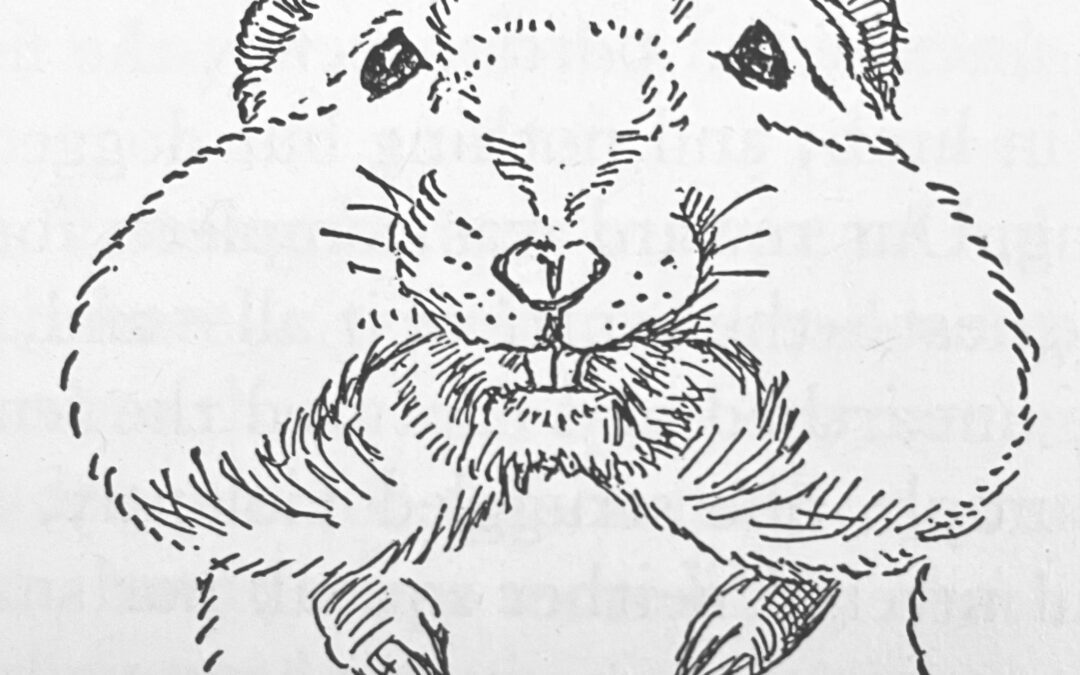
“Dipo with pouches filled” by Ernest Thompson Seton. Academy for the Love of Learning. All Image rights reserved.
Image publication: Lives of Game Animals, Vol. IV, pg. 432, based on pen and ink drawing. Maybe drawn from a museum specimen, possibly from Seton’s own collection.
Official Naturalist to the Seton Legacy Blog, Bob Hare, not only identified Dipodomys deserti, but also found the image in Lives. There seem to be a good many Kangaroo Rat species, or at least a lot of species names. The Natural History of New Mexico Mammals (Findley, 1987) lists three for New Mexico: merriami, ordii, and spectabilis.
By any name, they are adorable rats who jump around at night. The one described by Seton is a Mojave Desert species. Somehow surviving in the wasteland, but wait, here is what Seton says about the environment:
“Oh, why do they call it a desert? A desert is commonly understood to mean a barren, burning land deserted by all living things—even plants—cheerless, dreary, appalling, and death-dealing. It would be hard to get further from the truth than this…. (pg. 422, LGA).
Seton learned the love the little guys on his Lobo hunting trip (1893-94). He first noted the fairy-like footprints of the rats before he saw one. I have elsewhere gone into considerable detail on how that short period changed his relationship to religion and to nature. In “The Kangaroo Rat” (Lives of the Hunted, pg. 239) Seton gives us more insight into his thinking.
Fairie
“If only this had been in England or Ireland, any peasant could have explained it [the footprints] offhand—invisible pairs of tiny, furry boots, dancing in the moonlight—why, the verist idiot knows that—fairies, of course.
If only it could be! Would it not be delightful? I would gladly have believed. Christian Anderson would have insisted on believing in it, and then made others believe it, too. But for me, alas! impossible, for long ago, when my soul came to the fork in the trail marked on the left, ‘To Arcadie,’ on the right “To Scientia,” I took the flinty, upland right-hand path. I had given up my fayland eyes for—for I do not know what.”
But did he? As in his earlier Wild Animals I Have Known, this book, Lives of the Hunted, consists mostly of biographical portraits of imagined animals: “The material of the accounts is true. The chief liberty taken, is in ascribing to one animal the adventures of several.” (Lives of the Hunted, Pg. 9)
This left him open to attacks by critics who felt his stories sometimes contained more Arcadie than Scientia. But who knows, really? While much has been written about the natural history of the Kangaroo Rat, what do we know of their feeling world, their loves and hates? Whatever insights may be hidden in their hearts and brains will likely be forever hidden from us. Much of what we know will be the stories we tell ourselves about them, not the stories they tell about themselves.