
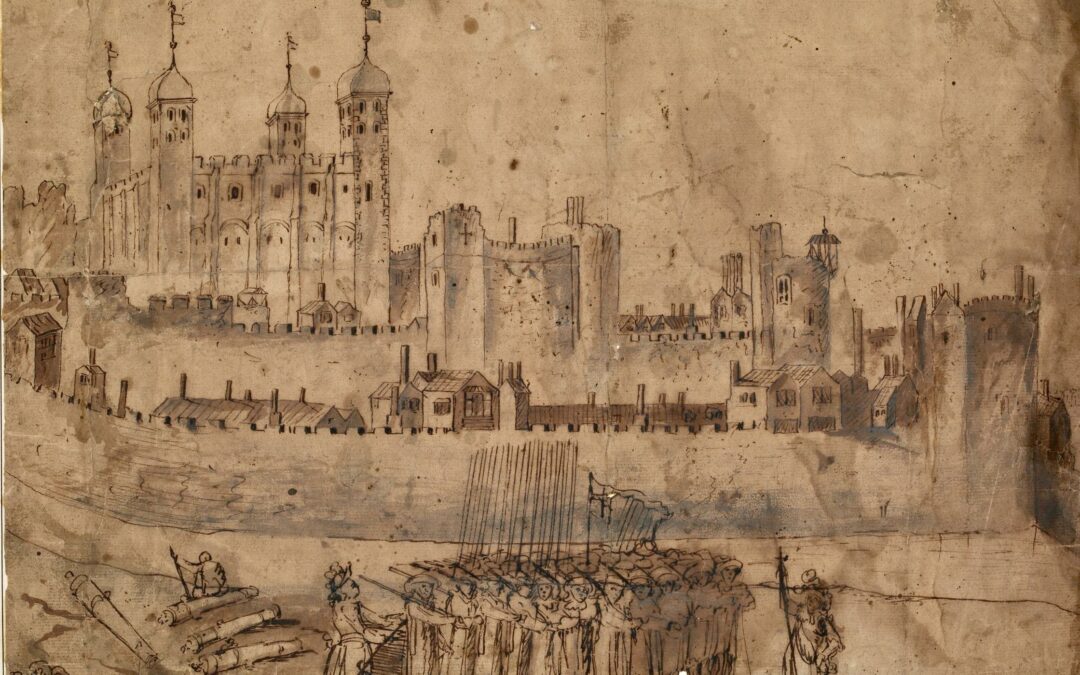
Soldiers parading in front of the Tower of London, viewed from the wharf. Pen and ink with brown wash. Artist name unknown. Date uncertain but depicting the Tower as it appeared early eighteenth century. Museum number: G,9.95. © The Trustees of the British Museum.
The 1716 trial of George, Fifth Lord Seton, Ernest Thompson Seton’s ancestor, reaches a surprising conclusion.
March 19, Third Day Of The Trial
On the third day, the prosecutor allowed as how a Catholic might be a Jacobite, but Seton was a Protestant, so he erred not only against the State but against his own religion as well. Seton’s counsel suggested that his client might not be mentally competent, a mitigating factor. But as the verdict was in, it didn’t matter.
March 31, 1716. Seton had not been sentenced, but the Winton honors (and property?) had been snapped up by Archibald, thirteenth Earl of Eglinton (distant relative of the Setons). The Advocate found a statement by a lawyer who handled the transaction of the Winton title. He wrote, “We are informed (from London, under date March 31) the Earl of Winton will be pardoned and sent to Scotland under confinement.” This beat being eviscerated but was far short of victory. Nevertheless, he remained imprisoned in the Tower while the details were worked out.
Extra! Extra! Read All About It!
This just in from the Scots Courant, August 13, 1716, from intelligence, London, August 7: “The Earl of Winton made his escape out of the Tower last Saturday, about nine o’clock. This week the Earl of Winton’s servants were discharged out of the Tower.” (Pg. 270)
Even more fascinating is that Seton had been working on Plan B all along, beginning the process of filing his way through prison bars as early as March 17. He had worked as a blacksmith, so he knew a good deal about metal. Seton, still a young man, jumped from a window (height unknown) to the ground, apparently wearing a wig. His servants brought him a file? A wig? The two guards attending him were inattentive at the same time when he made his escape?
Cut to: He walks out of the tower, catches a ride to Italy, and retires to Rome.
How Did He Really Do it?
Who was in on it? Who got him out of London?
Observers at the time suggested that Seton played the fool during the trial to play for time. But a better theory is that the government itself, finding the execution of Seton a potential P.R. disaster, facilitated his escape from the Tower. The government had already secretly canceled his execution. The majesty of the Seton name after 600 years of service to various monarchs was a stellar record achieved by no other family. While Seton was present at Preston, there were no witnesses supporting the prosecution claim that he had engaged in combat.
From the perspective of over 300 years later, given the attack on Seton’s house prior to Preston, it begins to look like a setup to deprive this less-than-stellar man of his property.
Further, the chronology of the story doesn’t add up. Seton escaped after the trial, but he sawed through the bars of his jail cell before his trial? And no one noticed? The Advocate describes another version where, it was said, a large, very strong “gipsie” carried Seton out in a hamper filled also with his personal effects.
We know nothing about his subsequent life in Rome after losing his fortune. Perhaps he lived under an assumed name as protection against English agents. His grave is lost but may be near the Via Flaminia.
Posthumous Royal Pardon?
Two trials, two losses. The legal mess that the Earl of Winton found himself in during 1716 reverberated right down to the 1825 trial of George Seton the Saddler. The issues remain: George 5 was or was not legally separated from his property. George 5 was or was not legally married.
I believe that George, Lord Seton and Fifth Lord Winton did not receive a fair trial. On his behalf, I now call on the Government of the United Kingdom of Great Britain and Northern Ireland, Ministry of Justice, to examine the facts of the case: the complicity or duplicity of Archibald, thirteenth Earl of Eglinton, and prosecutorial misconduct on the part of William Cowper. George deserves a Posthumous Royal Pardon.
The Advocate quotes Sir Robert Douglas: “Thus terminated one of the principal houses in Great Britain, subsisting for upwards of 600 years in East Lothian, and from there spreading into several flourishing branches in Scotland.” (Pg. 272)
The End of the Seton Legacy?
The Seton name (under various spellings) survives as place and institutional names in the U.K., the U.S., and Canada. The names Seton, Thompson, Cameron, et. al. have thrived on at least two continents.
In 1898, Ernest Thompson Seton published Wild Animals I Have Known. He soon became the most famous Seton since George, Fifth Lord Seton (Not to be confused with George, Fifth Lord of Winton and Twelfth Lord Seton.) But while that George ultimately failed in his lifelong quest to save Mary, Queen of Scots, Ernest reestablished the family name in spectacular fashion.
If they were looking down from somewhere, the many Setons named George must have been pleased.
Special thanks to Karen Hancock and to George Seton, Advocate. This series would not have been possible without their diligence and amazing research.