
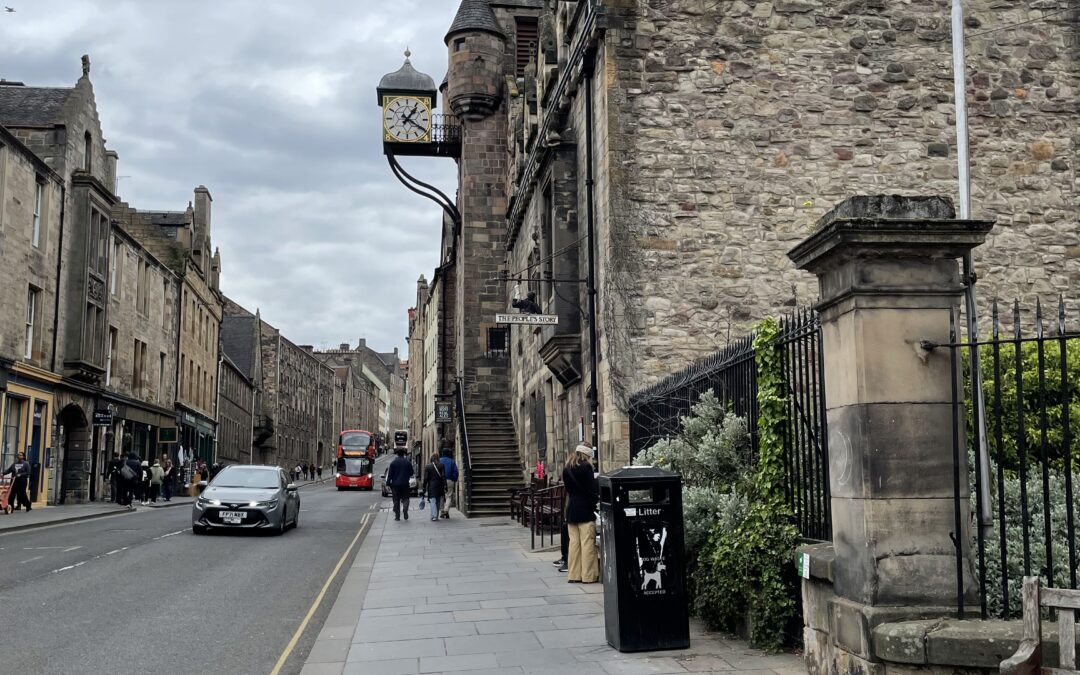
“Edinburgh, The Tolbooth and Cannongate” by David L. Witt, May 7, 2026.
Legal proceedings by George Seton to claim the title of Earl of Winton took place at the Cannongate courthouse in Edinburgh in 1825. I searched for it during a recent visit to that city. I knew that the building was located on High Street, towards the lower end of the “Royal Mile.” Unsuccessful in my search, I happened upon the Museum of Edinburgh. I asked if they knew the location of the historic building. They did. The helpful receptionist pointed to it on the opposite side of the street.
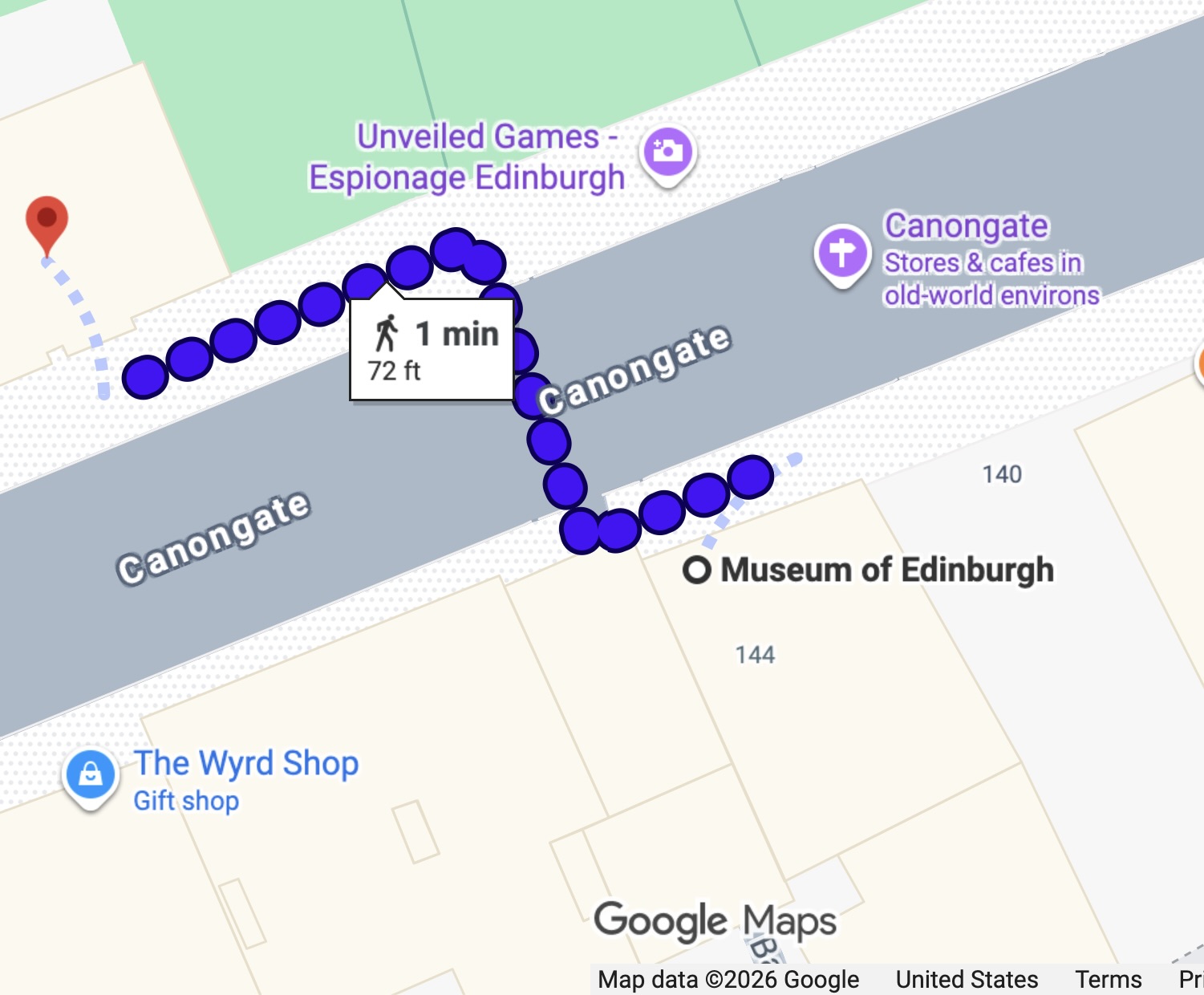
Screenshot
The Tolbooth (red maker above) is now occupied by The People’s Story Museum. The courtroom where George made his case is on the first floor (equivalent to the American second floor) but holds little hint of its 1825 appearance. The exterior of the building, however, is little changed from a century and a half ago.
If It Please The Court
A brief review of our True Law story from the previous two essays: Ernest Thompson Seton and his great grandmother’s brother George Seton both believed that the hereditary title of Earl of Winton should be recognized as a legitimate part of the Seton family legacy. This George sought to become the Sixth Earl of Winton.
As documented in Seton, the Earls of Winton, edited by Karen Hancock, the earlier George Seton, Fifth Earl of Winton, faced the charge of Treason against the King due to his support of the Jacobite uprising of 1715. He faced two punishments: 1) The loss of his title. 2) The loss of his head.
In his defense, George claimed extenuating circumstances while reminding the court that “I am descended from a very ancient and noble family whose blood the streams of loyalty were always pure and never corrupted with treason or sedition.” (Pg. 46) This was true and could have been attested to by William Wallace had he still been around. (The Seton-Winton family traced its roots in Scotland back to the twelfth century.)
At this point, in a Michael Connelly Lincoln Lawyer novel, we might find this:
Prosecutor: Objection. The bloodline of ancestors, pure or not, is immaterial to the current charge.
Judge: Sustained!
George went on to explain the circumstances of his actions. The Lothian militia attacked and destroyed his home (Seton Palace) and attempted to kill him. To save his life, he took refuge with a group of men in a safer location. This group turned out to be Jacobites who battled the government at the Battle of Preston in November 1715.
If It Not Please The Court
George claimed he was the victim of guilt by association: “I never joined with them in any act of hostility.” If true, then even under duress, having lost his home and still under threat of death, he nonetheless took no part in the rebellion. The court, however, concluded that George was in fact an active supporter of the pretender to the throne, James Stuart. Whether or not he engaged in “hostility” cannot be known, but he could not explain away the fact of his leading a company of soldiers at Preston—who were defeated and captured. The trial was held in the late winter of 1716; presumably the guilty verdict was not long in coming. For whatever reason, the sentence of execution was not immediately carried out. A mistake on the part of the government. George escaped the Tower of London in August.
But an important mystery remains: George did not give a motive for his being attacked by the Lothian militia, the font of all this misery in the first place. Maybe further explanation could have explained the circumstances? Or perhaps the circumstances were well known at that time, requiring no special mention. In the event, the later George Seton (the one who wanted the title restored) accepted the verdict of Treason against the earlier George as legitimate.
I will speculate that the Lincoln Lawyer (Mickey Haller) might have advised against this as a legal strategy. By conceding the legitimacy of the Treason charge against the earlier George, the younger George missed an opportunity to contest the legality of extinguishing the title Earl of Winton title. Reinstating the title just because the younger George wanted to be an Earl doesn’t strike me (a non-lawyer) as a strong position. A better approach would been to claim that the guilty verdict of 1716 was itself wrong, and that therefore, revoking the title was illegal, representing the actions of an out-of-control prosecutor who answered to the King.
The King was unhappy about any opposition to his rule and enthusiastic about using the justice system to pursue his own personal vendettas against perceived enemies.
[We will rejoin the younger George in Part IV of this series.]
True Law Bonus Blog Content
A quick True Law literary quiz: Can you identify which one of the three quotes below I have altered from the original?
“We’re a dramatic people,” Perry Mason said slowly. “We’re not like the English. The English want dignity and order. We want the dramatic and the spectacular. It’s a national craving. We’re geared to a rapid rate of thought. We want to have things move in a spectacular manner.” Erle Stanley Gardner, The Case of the Howling Dog
“A marriage certificate! a marriage certificate! my kingdom for a marriage certificate!” Shakespear, The Tragedy of King Richard the Third
“The Lawyers have twisted it into such a state of bedevilment that the original merits of the case have long disappeared from the face of the earth. It’s about a Will… It’s about nothing but Costs now”. Charles Dickens, Bleak House