
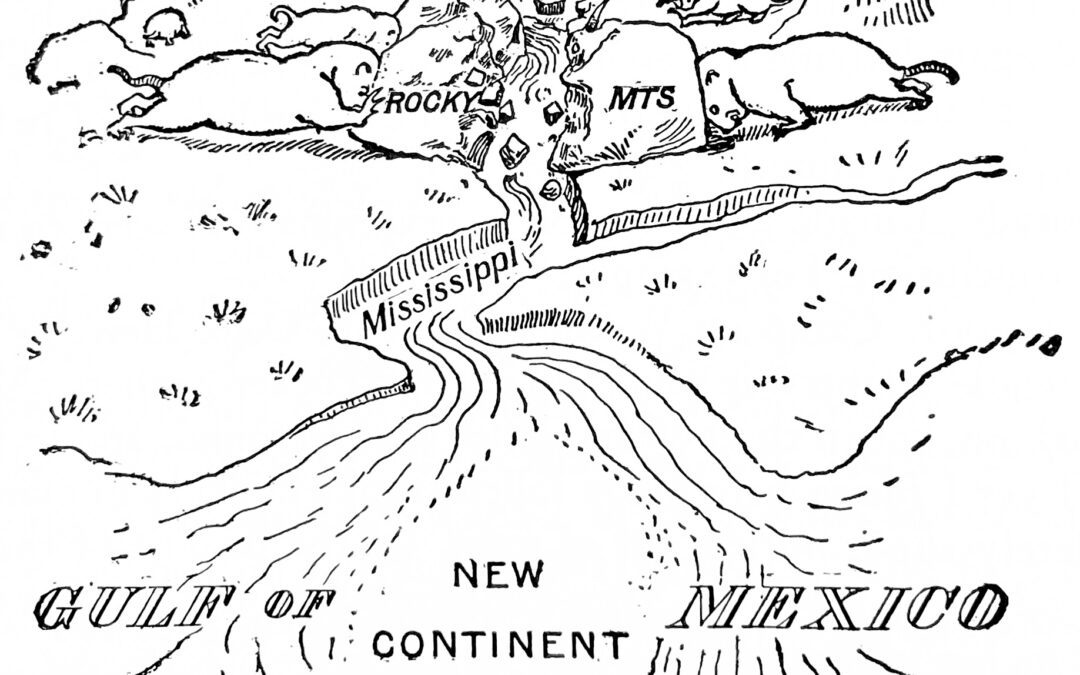
New Continent by Ernest Thompson Seton
According to Ernest Thompson Seton, Pocket Gophers reshape the landscape by moving vast amounts if earth each year. The little creatures have a special task—tearing down mountains and creating new continents from the debris. The illustration above sent me burrowing back into the deepest reaches of Lives of Game Animals to find out more. (Vol IV, pg. 414-418, abridged.) Of course, the Rocky Mountains do not drain into the Gulf of Mexico via the Mississippi, but instead by way of the Rio Grande.
This repeats some of “Dig This Seton and Pocket Gopher”
NUMBER OF MOUNDS AND SIZE
“We have already noted the vastness of the area inhabited by the Pocket-gophers, their ubiquity in that area, the greatness of their numbers, and the assiduity of their labours. Let us now look at the results in detail, and, finally, in mass.
On April 29, 1904, at Whitewater, Man[itoba], E. W. Darbey and I staked off 20 yards square in the middle of a large Gopher tract, then carefully counted the hills—there were 78. We then measured in a bushel measure a number of the mounds, and found that an average one was a good half bushel, a large one 2 bushels. Altogether, they represented about 40 bushels of earth. All these had been made apparently that season.
In the Sierra, Sept. 23, 1899, I saw 10 large hills thrown up in one day from one tunnel; many extensive areas had had the surface wholly turned that year.
In another Sierra valley, Sept. 24, 1899, I saw 15 fair-sized hills thrown up within 24 hours, apparently by a single Gopher; and scattered with them were 32, so recent that only one inch of their exterior was dry. All were within a radius of 15 feet. The aggregate of these 47 hills thrown up in two days, was not less than 25 bushels of earth.
An even better illustration I observed on the South William River of Colorado, Sept. 16, 1901. Under the shade of some scattering aspens where we were camped, I measured off a space 24 feet square, and carefully plotted the Gopher mounds on it. The firm outlines are around the hills that were less than a week old, the dotted lines mark hills about a month old, but the whole surface had evidently been turned this summer; the ground was so soft that the Horses sank 6 to 10 inches in walking across it.
The California example shows that 75 hills on its area of 57 square yards; at this rate, there would be 6,000 hills to the acre. An average hill among these, was 18 inches across and 4 inches high, as nearly as possible one-third of a bushel; therefore 2,000 bushels per acre were upheaved within two or three months by the Pocket-gophers—enough to cover the whole area evenly to the depth of one inch.
MAGNITUDE OF HIS WORK
From the sum of all these observations, I conclude that these animals completely plough the surface of the country, that is turn it all over at least once in two years.
They are more or less active the year round; and even halving the lowest estimate of their numbers to cover sparsely populated regions, and again halving the estimate of their work to allow for periods of comparative idleness, we shall still have an even upheaval of between two and three inches per annum.
Sept. 22, 1901. Camp on Wilson’s Flat-top, Colo. Here, as elsewhere noted, the whole country is ploughed up by Pocket-gophers. Aspen logs with the bark on, rot in three years, if set in the ground, and in five above ground; and yet I found here many fallen trunks 8 inches in diameter that were completely sunk, buried out of sight, by the labours of these miners before the wood was at all rotted. This would mean an upheaval in that place of at least 8 inches in less than 5 years.
Darwin concluded that the earthworms in five years bring up soil enough to cover the ground one inch thick; and that, therefore, the result of their labour is of vast importance. I reckon that the Pocket-gopher does this much in five months. It does not do it in the same way or so effectively, because the earthworm actually digests the substance of its castings; but it is evident that the Gopher’s method answers the purpose of fully disintegrating and mixing the dead vegetation with the soil to produce a rich and fertile black loam.
DOWN AND DIRTY
From these observations, we may form some idea of the work toward tilling and draining the ground done by this continental army of rodents, and it is possible that they cause still greater changes by bringing such vast quantities of soil under the influence of the sun and wind.
Their aggregate power as active geological agents must be immense; and when we stand on the banks of the Mississippi, and watch that turbid river bearing its 400,000,000,000 tons of mud per annum to the sea, i.e., I square mile, about 240 feet deep, 10 for the manufacture of new continents, we should realize that a great many thousand million tons of that flood-borne silt is simply the débris from the workshop of the Geomyida.”